.png)
01
What happened
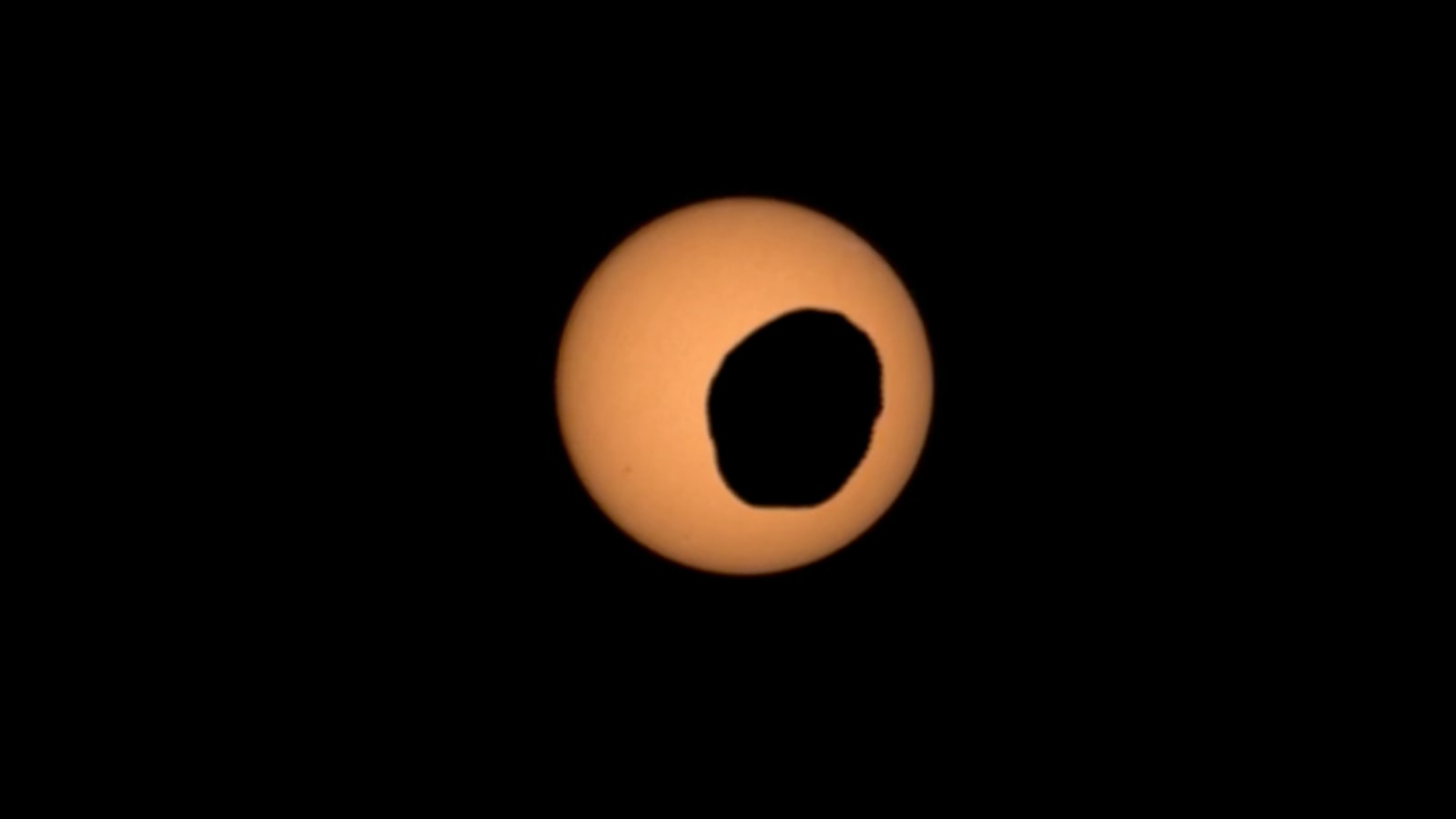
Perseverance captured the transit on August 12, 2026, during mission sol 1,948, using the rover's Mastcam-Z camera system. NASA published the sequence on August 24 as PIA26811. Phobos appears as an irregular silhouette moving across the solar disc, seen from Jezero Crater.
NASA says the animation was tinted to approximate what a person would see through protective solar-eclipse glasses. Repeated eclipse observations from the Martian surface help researchers refine Phobos's orbit and study how it changes over time.
02
Why it matters
The image works on two levels: it is a precise observation with a traceable instrument and mission record, and it is an unusually legible photograph of orbital motion. The processing note matters because the published colour is a presentational choice, not a claim of untouched human vision.
03
What we're watching
We are watching the next Perseverance and Curiosity eclipse sequences and the orbital models built from the combined record. This single image does not by itself measure the full rate of Phobos's inward migration.