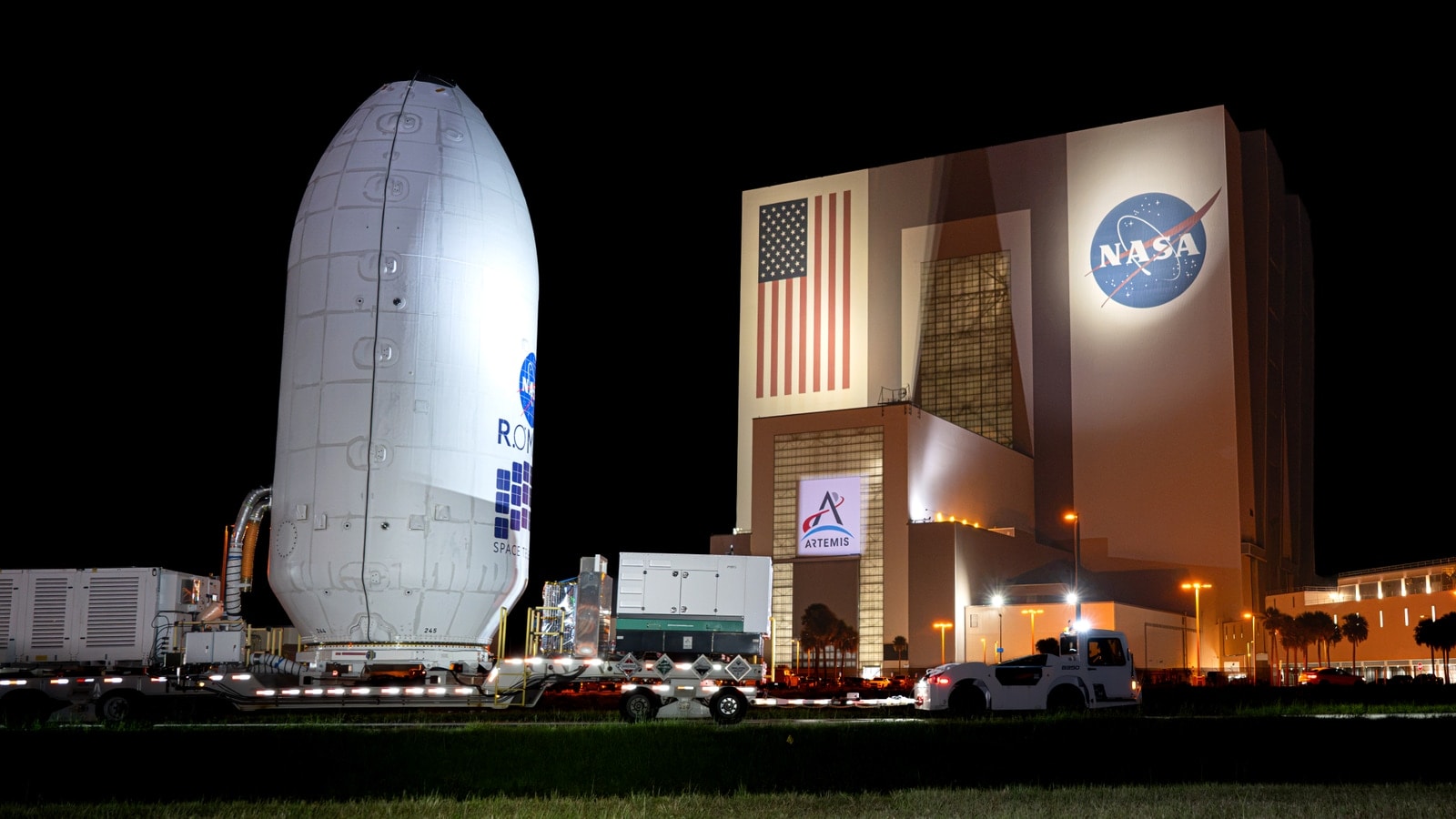
What happened
NASA says Roman is targeted to launch no earlier than August 30 at 7:26 a.m. EDT aboard a SpaceX Falcon Heavy from Launch Complex 39A at Kennedy Space Center. That is a target, not a guaranteed liftoff time; weather and technical conditions can move it.
The telescope's Wide Field Instrument uses a 300-megapixel infrared camera. NASA says a single view covers at least 100 times Hubble's field while retaining comparable resolution, allowing large surveys of dark energy, exoplanets and the infrared sky.
After launch, Roman is planned for a roughly 1.5-million-kilometre journey to the Sun–Earth L2 region. Commissioning follows; NASA currently expects the first science images in early 2027 rather than immediately after launch.
Why it matters
Roman's visual promise is scale, not merely another sharper picture. Hubble often gives astronomy a narrow, extraordinarily detailed window; Roman is designed to retain comparable resolution across far wider areas. For visual researchers, the important change is statistical: many more galaxies, stars and transient events can be observed under one consistent imaging system.
What we're watching
Before publication or launch coverage, MANAZYR must recheck NASA's live schedule. After liftoff, the meaningful checkpoints are deployment, the cruise to L2, commissioning and the first calibrated science images. The launch photograph documents payload transport; it does not prove mission performance.